UFORCE raises USD 700m at a USD 6bn valuation to scale Ukrainian drone production
The maker of the MAGURA sea drones and NEMESIS strike drones will use the money to build production in Ukraine and allied countries. The round values it six times higher than in March.
UFORCE, a defence technology company founded in Ukraine and headquartered in London, has raised USD 700 million in a Series A round at a valuation of USD 6 billion, the company announced on Thursday 12 November. The round was co-led by Valor Equity Partners and the UK National Wealth Fund, with participation from the U.S.-Ukraine Reconstruction Investment Fund (URIF).
The company raised USD 50 million at a valuation of around USD 1 billion in March, CNBC reported, which means the new round values it roughly six times higher eight months later. Axios described the USD 6 billion figure as a post-money valuation.
Who invested
Alongside the two lead investors, the round drew Menlo Ventures, Xantium and Hiro Capital, while existing backers Shield Capital, Ballistic Ventures, Lakestar and Squadra increased their stakes, according to the company. General (Ret.) Christopher G. Cavoli, a former NATO Supreme Allied Commander Europe and now a partner at Valor Equity Partners, joins the UFORCE board.
URIF's money is earmarked for UFORCE's operations in Ukraine, including staffing, research and development and new products. Conor Coleman, head of investments at the U.S. International Development Finance Corporation, said on behalf of the fund that it was URIF's largest investment in emerging technology to date. Chief executive Oleg Rogynskyy declined to tell Axios whether any of the funding is secondary, or whether the National Wealth Fund's commitment comes with jobs or manufacturing requirements.
Oliver Holbourn, chief executive of the National Wealth Fund, said the expansion would bring the production, engineering and use of combat tested autonomous systems to the UK and help create high skilled jobs.
What UFORCE builds
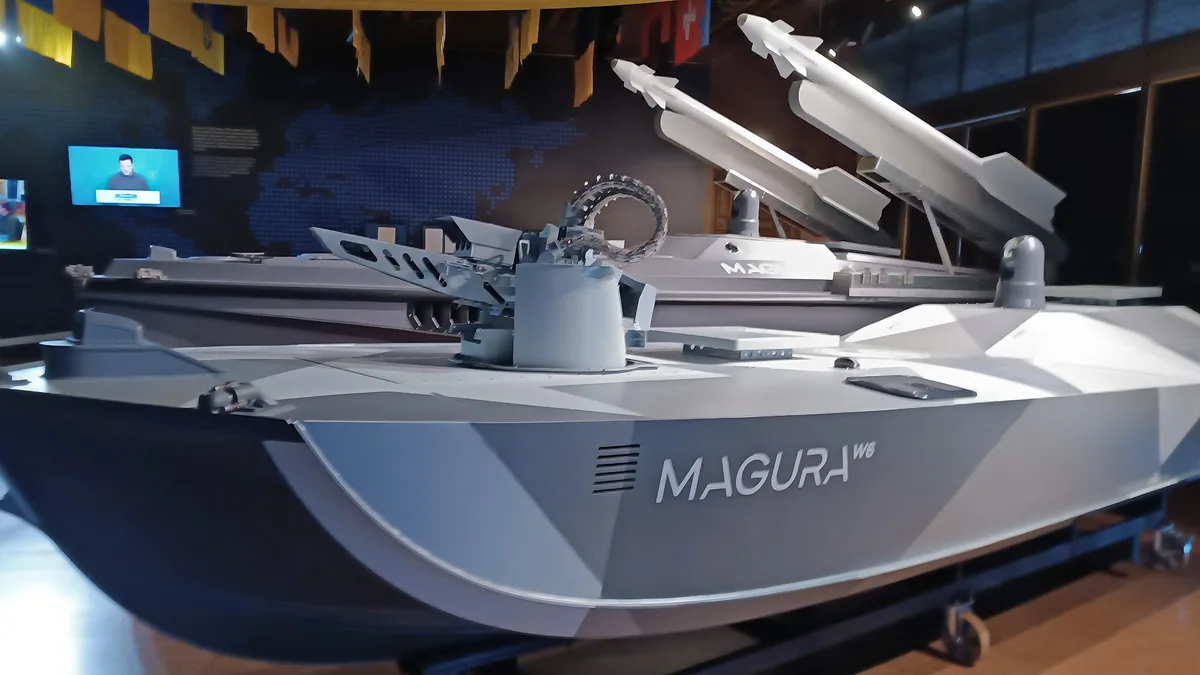
UFORCE makes uncrewed platforms for sea, land and air, plus the AI software and command and control layer that runs them. Its products include the MAGURA family of uncrewed surface vessels, the NEMESIS strike drones, the LIUT ground robots and the PREDATOR counter drone turrets. The company says MAGURA vessels have contributed to the destruction of more than a dozen Russian warships in the Black Sea and that NEMESIS drones have flown more than 300,000 combat missions across more than 100 units. These are company figures.
The new capital will fund manufacturing across the US, Europe, Asia-Pacific and the Middle East, close to where the systems are needed, and expanded research and production of its four product families. UFORCE recently partnered with ReconCraft to build MAGURA vessels in the US and is a founding member of the EU-Ukraine Drone Alliance.
Growth and valuation
Rogynskyy told CNBC that bookings have more than doubled over the past year from a base of several hundred million dollars, without giving exact figures. "In terms of valuation to bookings, valuation to revenue, this is actually not an aggressive valuation," he said, adding that the company had received offers at higher valuations but chose this group of investors. He also said UFORCE meets Ukrainian military needs first before supplying overseas customers.
"UFORCE and our investors are united in our determination to make aggression unaffordable," Rogynskyy said in the announcement, in which the company set out its goal of making defence a hundred times cheaper than offensive operations.
What it means for European founders and investors
A USD 700 million Series A is exceptionally large for a company at this stage, and it shows that battlefield proven hardware is now the strongest card in defence tech fundraising. CNBC cited a Dealroom and Resilience Media report showing that startups across NATO and allied countries raised USD 27.1 billion through September, nearly double the total for the whole of 2025.
The investor mix matters as much as the size. A UK state backed fund, a US development finance vehicle and Silicon Valley venture firms sit in the same round, which shows how public money is being used to pull private capital into defence manufacturing. For founders, that means sovereign and development funds are becoming realistic co-investors, but usually with expectations about where production and jobs end up.
For smaller defence startups, a well funded UFORCE is both a benchmark and a potential partner. Its plan to convert existing maritime and automotive capacity in allied countries could create demand for component suppliers, software firms and contract manufacturers across Europe. For more on the sector, see our reports on SE3's Series A, Tekever's Danish expansion and Germany's stake in KNDS.
Spotted an error? Email contact@europreneursmedia.com and we'll correct it. See our corrections policy and editorial standards.