Dcubed raises EUR 27.2m to scale space hardware and solar arrays
The Munich area company, which sells ready to order release actuators and solar arrays, will expand factories in Germany and the United States and test a 2 kW origami style solar array in orbit.
Dcubed, a German maker of release actuators, deployable space hardware and power systems, has closed an oversubscribed EUR 27.2 million Series A+ round, the company and its investor HTGF announced on 18 November. The round was led by Warsaw Equity Group (WEG), with the European Innovation Council (EIC) Fund, the HTGF Opportunity Fund and existing investors including BayBG and Expansion.
SpaceNews put the amount at nearly USD 30 million. The money will be used to scale production in Germany and the United States and to bring a new family of solar arrays, called ARAQYS, to market.
What Dcubed makes
Dcubed was founded in 2019 and operates from Germering near Munich and Berthoud in Colorado. Its products are the small but critical mechanisms that release and unfold parts of a spacecraft, such as solar panels and antennas, once a satellite is in orbit. It also makes solar arrays. The company says it has more than 170 customers worldwide and more than 500 products in space, and that it more than doubled both production and revenue year on year. Its team has grown to 87 people.
The company's pitch is to make space hardware off the shelf. Much of the industry still relies on custom components with long lead times and fragile supply chains. "Our ambition is simple: make space hardware as easy to buy and use as anything on Earth," said founder and chief executive Thomas Sinn.
Where the money goes
Dcubed says the round funds two priorities. The first is industrialising production of its flight proven release actuators and solar arrays in Germany and the United States, with the goal of quadrupling production capacity. A substantial share will go into production equipment, automation, staff and supply chain capabilities.
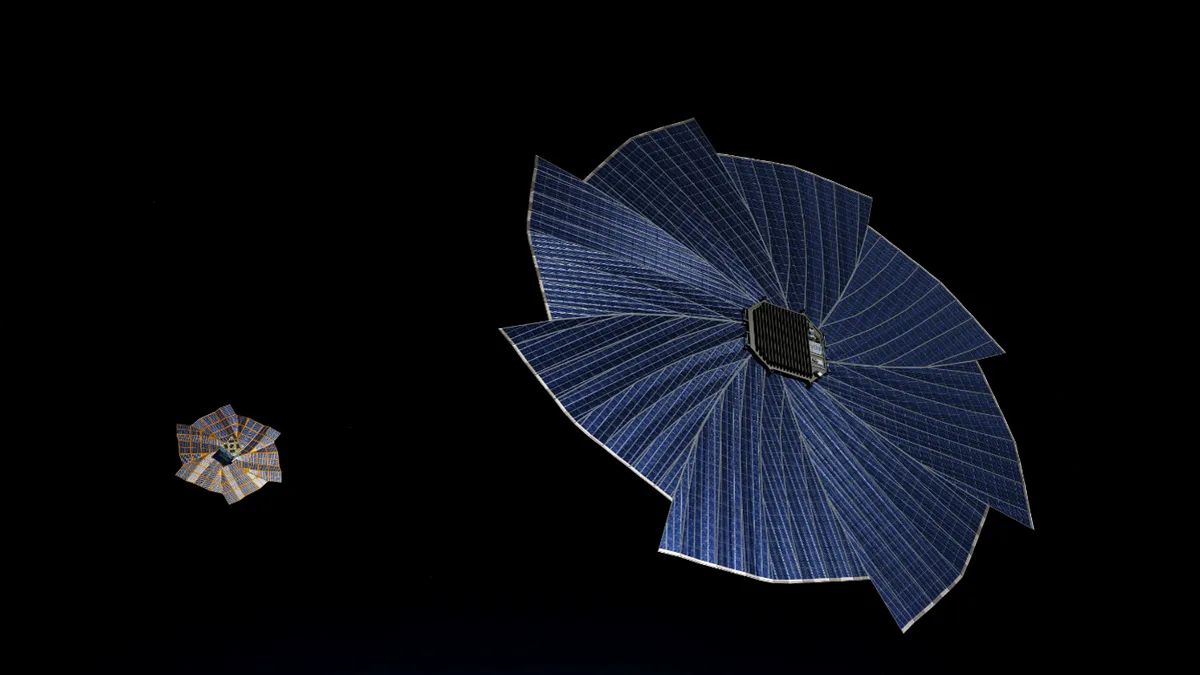
The second is ARAQYS, a family of solar arrays and power systems. Its first design, HALO, is a radial, origami folded array that packs a large solar area into a small launch volume and uses widely available silicon cells. Dcubed says it aims to cut the cost per watt of space power by one to two orders of magnitude and open a path from today's kilowatt class systems to tens and eventually hundreds of kilowatts.
A 2027 test in orbit
The first HALO array is planned to fly in 2027 on a SpaceX rideshare mission as part of ARAQYS-D3, a 2 kW in-orbit demonstration. The mission will also deploy a 10 metre boom manufactured in space, and five power beaming partners will fly on it, according to the company.
The investors' view
"Reliable and affordable power will be essential to the next generation of activities in space," said Helen McBreen, board member of the EIC Fund. Christian Ziach, principal at HTGF, which has backed Dcubed since its seed round, said the company "now needs to industrialize and scale its production." Jan Szumada of Warsaw Equity Group said the firm sees Dcubed as "one of the few European space companies positioned to become critical infrastructure for the global space economy."
The lead investor, Warsaw Equity Group, is based in Poland, and Polish business media covered the round widely. A Polish growth investor leading a round in a Bavarian space company is a useful sign that capital from Central Europe is also backing deep tech outside its home market.
What it means for founders and investors
European space investment has shifted towards companies with defence relevance and real revenue, as seen in ICEYE's bid for Avio. Dcubed fits a less visible but important part of that market: component suppliers that many satellite makers depend on. For hardware founders, its story shows the value of standard, catalogue products in an industry used to bespoke engineering, since repeatable products make it possible to scale manufacturing and margins.
For investors, the round combines public money from the EIC Fund and German state backed vehicles with private growth capital. That mix has become a common way for European deep tech companies to fund factories before they are large enough for traditional growth equity. The ARAQYS demonstration in 2027 will be the key test of whether Dcubed can move from components into the much larger market for space power.
Spotted an error? Email contact@europreneursmedia.com and we'll correct it. See our corrections policy and editorial standards.