Biomatter raises EUR 16.2m to design enzymes that do not exist in nature
The Lithuanian startup, whose customers include AstraZeneca, BASF and Sanofi, will open a new facility in Vilnius in 2027 and grow its US presence, where about half of its customers are based.
Biomatter, a Vilnius based company that uses AI to design custom enzymes, has closed an oversubscribed USD 18 million (EUR 16.2 million) Series A round led by Astanor, the company announced on Thursday 12 November. Existing investors UVC Partners, Inventure and Metaplanet also took part.
The company did not disclose a valuation, The Next Web reported. Most of the money will go into a 2,000 square metre design and testing facility in Vilnius, due to open in 2027.
What Biomatter does
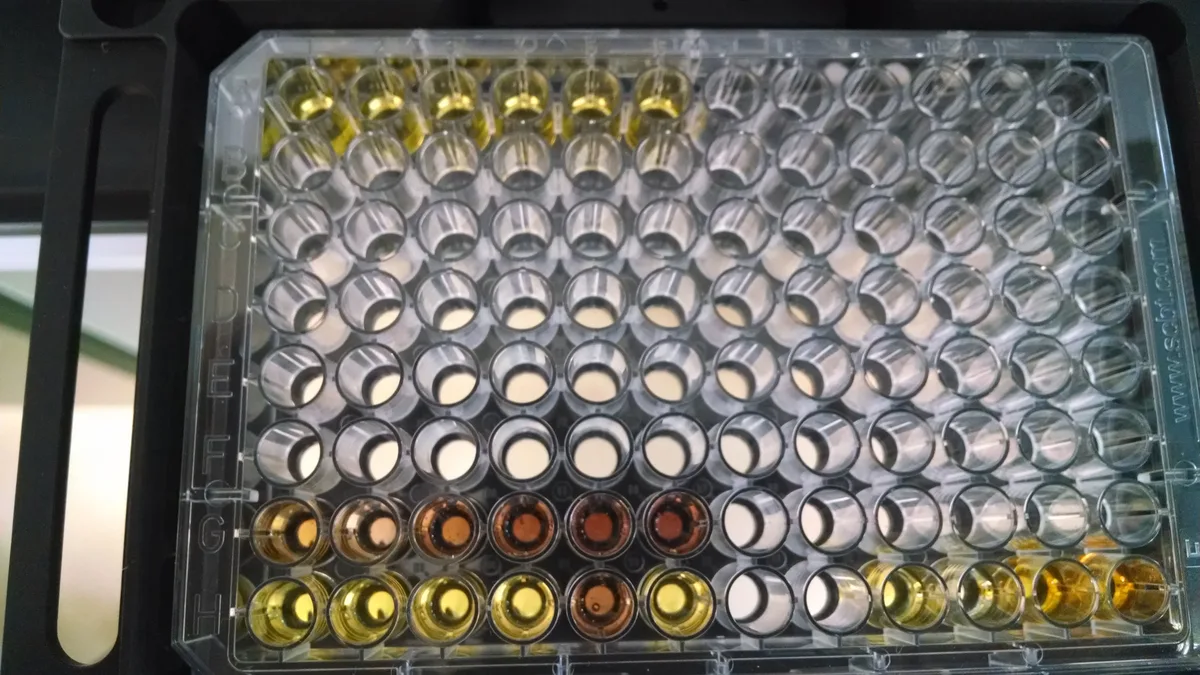
Enzymes are proteins that speed up chemical reactions, and industry uses them to make medicines, food ingredients and laboratory reagents. Most commercial enzymes start as natural ones that scientists then modify. Biomatter instead starts from the chemical reaction a customer needs and designs an enzyme for it, combining computational models with lab testing. Each project adds new experimental data to the dataset its models learn from, the company says.
"Our goal is to make a custom enzyme as easy to order as a catalog product, including for reactions that don't have one today," chief executive and co-founder Laurynas Karpus said in the release, as quoted by The Next Web. The company was founded in 2018, and its founders published their approach in Nature Machine Intelligence in 2021.
Customers and products
Biomatter says it has delivered more than 50 custom enzymes to more than 25 enterprise customers in Europe, the US and Japan, including AstraZeneca, BASF, Kirin Holdings, Neogen, Sanofi and Tereos, according to The Recursive. About half of its customers are in the US. The Next Web noted that it had not independently verified these figures, which come from the company.
One product is already on sale. Biomatter worked with Thermo Fisher Scientific to improve the oxidation resistance of the Invitrogen SuperScript V reverse transcriptase, an enzyme used in molecular biology, which can now be shipped at ambient temperature. The company also says it designed a methylase for mRNA vaccine manufacturing that works without S-adenosylmethionine (SAM), a molecule such enzymes normally need.
The investors and the plan
Astanor is a Brussels based investor founded in 2017 that backs agrifood and bioeconomy companies and closed its second venture fund at EUR 360 million in 2023, The Recursive reported. Partner Harry Briggs said Biomatter "has spent years generating data beyond nature, which allows them to design enzymes that never evolved". UVC Partners and Inventure co-led Biomatter's EUR 6.5 million seed round in August 2024, and UVC increased its investment this time.
Conventional enzyme programmes take months or years, Biomatter says, while its own programmes run in weeks. The new Vilnius facility is meant to bring more of the build and test loop in house and cut that to days. The round will also fund a larger commercial team, a bigger US presence and further investment in its computational platform and enzyme dataset.
What it means for European founders and investors
AI for biology is one of the most crowded areas in tech, but Biomatter stands out because it already sells products and has repeat enterprise customers. That combination of proprietary lab data and commercial revenue is what Series A investors increasingly want to see in techbio, rather than models alone.
The round is also a signal for the Baltic ecosystem. The Next Web noted that it is another sizeable Lithuanian round after web data company Oxylabs raised USD 130 million in July, and a biotech deal of this size shows that deep science teams can be built and funded there. Building the lab in Vilnius rather than moving it abroad keeps high skilled jobs local while sales grow in the US.
For industrial and pharma founders, cheaper and faster custom enzymes could make greener chemical processes more competitive. For more on European techbio, see our reports on Orakl Oncology's Series A and bit.bio's Series D.
Spotted an error? Email contact@europreneursmedia.com and we'll correct it. See our corrections policy and editorial standards.