Alstom posts EUR 954m first-half loss and targets EUR 2bn debt cut
The French train maker confirmed the reduced outlook it issued on 2 November, put execution at the top of its agenda and opened a review of all options, including asset sales and equity funding, to protect its investment grade rating.
Alstom reported a net loss (Group share) of EUR 954 million for the first half of its 2026/27 financial year, compared with a profit of EUR 220 million a year earlier, the French train maker said on 17 November. Adjusted EBIT swung to a loss of EUR 396 million, a margin of minus 4.2%, from a profit of EUR 580 million.
The company confirmed the downgraded outlook it published on 2 November and said its board had started a review of all options, including disposals and equity or equity-like funding, to reduce debt by around EUR 2 billion by September 2027.
The numbers
Sales rose by 3% to EUR 9.33 billion in the six months to 30 September, or 2% on an organic basis, and orders grew by 5% to EUR 11.0 billion, giving a book-to-bill ratio of 1.2. EBIT was a loss of EUR 685 million, against a profit of EUR 316 million a year earlier. Free cash flow was an outflow of EUR 1.248 billion, compared with an outflow of EUR 740 million, which the company said reflected seasonality.
On an adjusted basis, the net loss was EUR 822 million, compared with an adjusted net profit of EUR 338 million a year earlier, Reuters reported. The tax line was also hit by a EUR 100 million write-down of deferred tax assets recognised in prior years, according to the release.
Net debt rose to EUR 1.104 billion at 30 September from EUR 404 million at the end of March. The increase was partly offset by EUR 694 million raised through hybrid bond issuance, and the group held EUR 1.625 billion in cash and cash equivalents.
Where the problems are
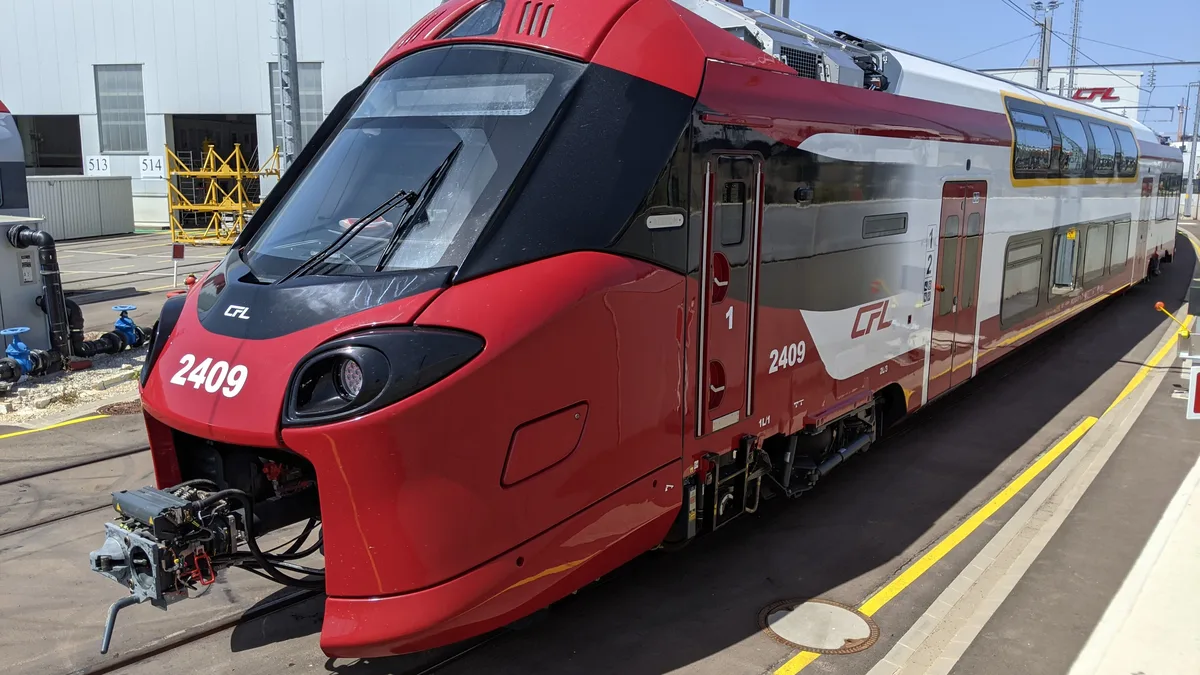
Alstom said project execution cut 1,000 basis points from its adjusted EBIT margin, driven by margin adjustments on projects executed for and from Germany. Its Coradia Max double deck platform faced technical issues that require a retrofit strategy, and the test programme was reinforced to move towards homologation and commercial service. The revised planning has affected production this year and the homologation timeline across the six project portfolio, the company said.
"First-half results reflect project execution challenges recently identified," chief executive Martin Sion said in the release. "We are acting decisively on the key levers to improve execution, including operating model and commercial strategy, while pursuing a EUR 2 billion deleveraging objective to reinforce the balance sheet." Sion took over in April 2026, according to Reuters.
Orders showed a shift in where demand is coming from. Intake in Europe fell to EUR 3.8 billion from EUR 5.2 billion, while Africa, the Middle East and Central Asia rose to EUR 3.3 billion from EUR 0.2 billion, helped by contracts in South Africa, Saudi Arabia, Israel and Egypt.
The outlook and the plan
For the full year, Alstom still expects to produce around 4,000 cars, organic sales growth in the low to mid single digits, an adjusted EBIT margin of around 1% and free cash flow of minus EUR 1.5 billion, as set out on 2 November. A broad review of its organisational and operating models will lead to decisions before the end of 2026, and a capital markets day covering footprint, products and medium term targets is planned for the second quarter of 2027.
The company said its board is committed to maintaining a solid investment grade credit rating. Reuters noted that Moody's revised its outlook on Alstom to negative on 9 November while affirming its Baa3 rating, the lowest investment grade level.
Why it matters
Alstom supplies trains, signalling and services to rail operators across Europe that are investing in new fleets for decarbonisation. A loss of this size, driven by delays on trains for German customers, shows how quickly large fixed price contracts can turn when a new platform struggles with industrialisation and approval. The 2 November guidance cut had already prepared investors for weak results; the new element is the scale of the balance sheet response.
A review that explicitly includes disposals and equity funding means Alstom could sell businesses or raise new capital within the next year. Neither has been announced, and the company has not said which assets could be involved.
What it means for founders and investors
For rail technology startups and suppliers, a large customer under financial pressure can cut both ways. Alstom will push for cost and procurement discipline, which can squeeze smaller vendors, but its focus on fixing execution, testing and homologation creates demand for tools that shorten approval cycles and reduce project risk, from digital testing to predictive maintenance.
For investors, the deleveraging plan is the key watch point. Any disposal process could bring rail assets to market for private equity and strategic buyers, while an equity raise would dilute existing shareholders. The pace of Coradia Max homologation in Germany is likely to decide how much of the second half recovery the company is counting on actually arrives.
Spotted an error? Email contact@europreneursmedia.com and we'll correct it. See our corrections policy and editorial standards.