Tendrils raises USD 30m led by Benchmark to rebuild the CPU for parallel computing
The Cambridge start-up wants to replace decades-old CPU design with a processor built on interaction nets, and is developing an open-source programming language to go with it.
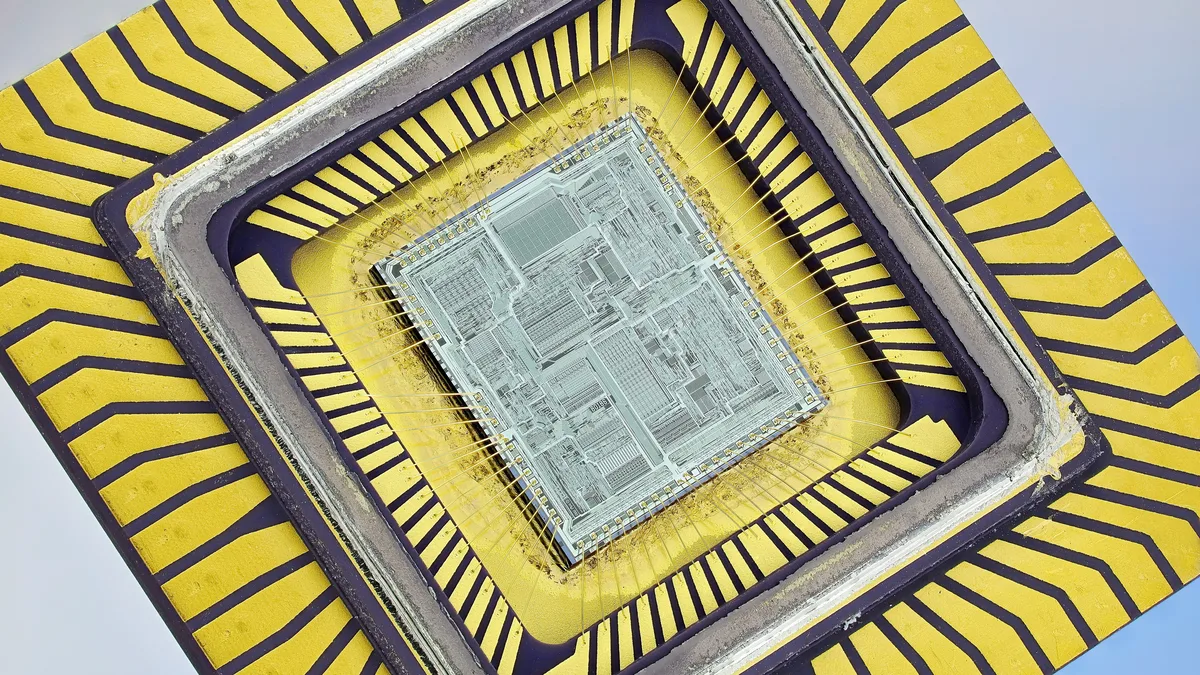
Tendrils, a semiconductor start-up based in Cambridge, UK, has raised USD 30 million in a round led by the US venture firm Benchmark. The company is designing a general-purpose processor with thousands of cores that run in parallel, instead of building on the sequential, single-core designs that today's CPUs still have to stay compatible with.
Visionaries Club, the UK Sovereign AI Fund, FR8, Antimatter, Cloudberry VC, Conviction, Embassy Ventures and SV Angels also took part, along with angel investors. Benchmark general partner Jack Altman has joined the board, Tech Funding News and EU-Startups reported. EU-Startups described the deal as a seed round of about EUR 26 million.
The problem Tendrils wants to solve
Modern processors carry design decisions that date back to the 1970s, Tendrils argues, because each new generation must run software written for older chips. As chipmakers add more cores, they rely on complex mechanisms such as cache coherency protocols, which keep shared data consistent between cores, and reorder buffers, which let instructions run out of order. In the company's view, these layers limit how far CPUs can scale.
Tendrils wants to start again. Its processor is meant to have thousands of cores working at the same time, without shared mutable memory or a single linear stream of instructions, the company said.
Interaction nets and the Vine language
The design is based on interaction nets, a model of computation in which a program is a graph of connected elements and each step is a small local rewrite. Because the steps are independent, many can run at once without the coordination that conventional multi-core chips need, EU-Startups explained.
A new chip is of little use without software that can exploit it, which has held back many earlier many-core projects, Tech Funding News noted. Tendrils is therefore also developing Vine, an open-source programming language with a syntax similar to Rust that compiles programs into interaction nets. Tech Funding News described Vine as still experimental.
Why investors are interested now
Visionaries Club partner Robert Lacher wrote in a blog post that the CPU is increasingly becoming a bottleneck for AI. AI agents rely on processors to run code, execute tests and search documents, and in some agentic workloads that tool execution accounts for up to 90% of end-to-end latency, according to his post. GPUs handle the large mathematical workloads, but much of an agent's other work still runs on CPUs.
The team and the earlier round
Chief executive Nils Cremer researched interaction nets at ETH Zurich. His co-founders are T6, who created Vine, and Hugo McNally, who previously worked at lowRISC, a Cambridge organisation that builds open-source chip designs, according to EU-Startups and Visionaries Club. Visionaries Club led a pre-seed round in summer 2025 with FR8 and angel investors, after first supporting Cremer with a small grant.
The UK Sovereign AI Fund is a government vehicle that normally invests GBP 1 million to GBP 10 million, Tech Funding News reported. The size of its stake in Tendrils was not disclosed, and the company has not disclosed a valuation.
A crowded field
Tendrils joins a growing group of European start-ups working on new computing hardware. EU-Startups listed recent rounds for London-based OLIX, Leeds-based Optalysys and Barcelona-based Openchip, among others. Tech Funding News pointed to AheadComputing, founded by former Intel architects, which builds CPU cores on the open RISC-V standard. Benchmark previously backed the AI chip company Cerebras in a 2016 Series A, according to the same report.
What it means for European founders and investors
A US firm leading a large seed round in a British chip start-up is a signal that deep hardware ideas from European universities can attract top-tier capital early. The round also shows sovereign funds acting as co-investors alongside private venture firms, a model the UK and the EU are both using to build domestic computing capacity.
The risk is high. Designing a processor from scratch takes years and large budgets, and a new architecture only succeeds if developers adopt its programming model. For founders, the lesson is that investors will back long technical roadmaps if the team is exceptional and the hardware and software are developed together. We covered other bets on new chip designs in our reports on Sparxity's Series A for sparse AI chips and Openchip's funding in Barcelona.
Spotted an error? Email contact@europreneursmedia.com and we'll correct it. See our corrections policy and editorial standards.