Eindhoven medtech Salvia BioElectronics gets EUR 25 million in EIB venture debt for its migraine implant
The InvestEU-backed loan supports the clinical development of an implantable neuromodulation system for people whose migraine does not respond to existing treatments, as a pivotal US trial gets under way.
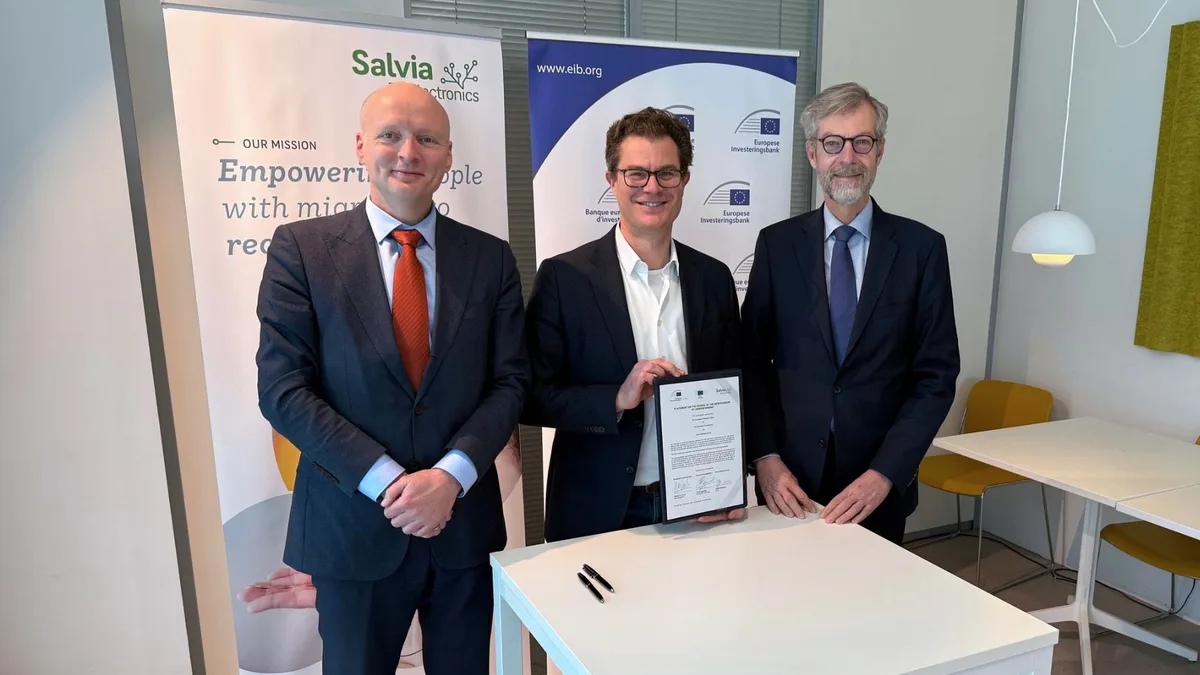
The European Investment Bank and Salvia BioElectronics have signed a EUR 25 million venture debt agreement to support the continued clinical development of the company's investigational MySalvia System, the EIB announced on Tuesday 24 November. Salvia, based in Eindhoven in the Netherlands, is a clinical-stage medical device company working on a therapy for people with resistant migraine.
The financing is backed by the European Commission's InvestEU programme. Dealroom reported that it sits under the EIB Group's TechEU programme. Salvia published the news on its own site with a photo of the signing.
What Salvia is developing
Salvia was founded in 2017 in Eindhoven. The MySalvia System is a minimally invasive implantable neuromodulation therapy built specifically for migraine. It combines two ultra-thin implants placed just beneath the skin with a small wearable device that delivers targeted electrical stimulation to nerves involved in migraine, according to the EIB. The device is investigational and limited to use in clinical studies in Europe and the United States.
Resistant migraine describes patients who still face significant disability after trying several preventive treatments. Salvia is also exploring whether its platform can help people with chronic cluster headache.
The clinical programme
In October, Salvia announced that the first patient had been implanted in RECLAIM-II, its pivotal US trial. The study is expected to enrol about 150 adults with resistant migraine at more than 20 sites across the United States and is designed to generate evidence for possible future regulatory submissions.
How the financing fits
Venture debt is a loan for companies that have already raised equity from professional investors but cannot get regular bank loans. The EIB's project page lists the operation as signed, with a total project cost of about EUR 59 million, of which the bank covers EUR 25 million. The bank says the loan extends Salvia's cash runway, reduces the risk in its development plan and is expected to help attract third-party investors.
The loan follows a USD 60 million Series B in May 2025, led by Innovation Industries, which Salvia said would fund the completion of clinical development and preparations for commercial launch in the US, Europe and Australia. Dealroom reported that Invest-NL and the EIC Fund also took part in that round.
What the two sides say
"Salvia is a great example of the kind of groundbreaking European innovation aimed at improving people's lives," said Robert de Groot, Vice-President of the EIB. Hubert Martens, co-founder and chief executive of Salvia, said: "We believe implantable neuromodulation can become an important new option for migraine care."
Cecilia Thorfinn, head of the European Commission Representation in the Netherlands, said the financing would help speed up the clinical development of a European medical technology in an area of high unmet medical need.
What it means for European founders and investors
Salvia's loan is the latest in a run of EIB venture debt deals for European deep tech and health companies. This week the bank also lent EUR 20 million to Swiss materials company Bcomp, and last week Gradyent secured EUR 20 million. For medtech founders facing long and expensive trials, this kind of non-dilutive debt can bridge the gap between equity rounds.
The risks remain clinical and regulatory. Dealroom noted that no implantable neurostimulation device for migraine is on the market yet and that Salvia faces competition from rival ShiraTronics, which is developing its own implantable system. Much will depend on the RECLAIM-II results.
For investors in the Dutch health tech scene around Eindhoven, the deal is a sign that public lenders are willing to back late-stage clinical companies that already have strong venture backing. More startup funding news is in our startups section.
Spotted an error? Email contact@europreneursmedia.com and we'll correct it. See our corrections policy and editorial standards.