Starforge raises EUR 6.6 million to build fusion reactors on production lines
The Munich company wants to sell standardised 200 to 300 MWe reactors to utilities rather than run power plants itself. It targets first commercial operations in the mid-2030s.
Starforge, a Munich fusion start-up founded in March 2026, has come out of stealth with a EUR 6.6 million pre-seed round co-led by AENU and First Momentum Ventures, the investor that incubated the company, First Momentum said on Thursday 26 November.
Auxxo, Kvanted, Silicon Roundabout Ventures, UnternehmerTUM Funding for Innovators and Arcas also took part, according to EU-Startups. The round was raised in eight weeks over the summer and was heavily oversubscribed, the company said.
A reactor vendor, not a power company
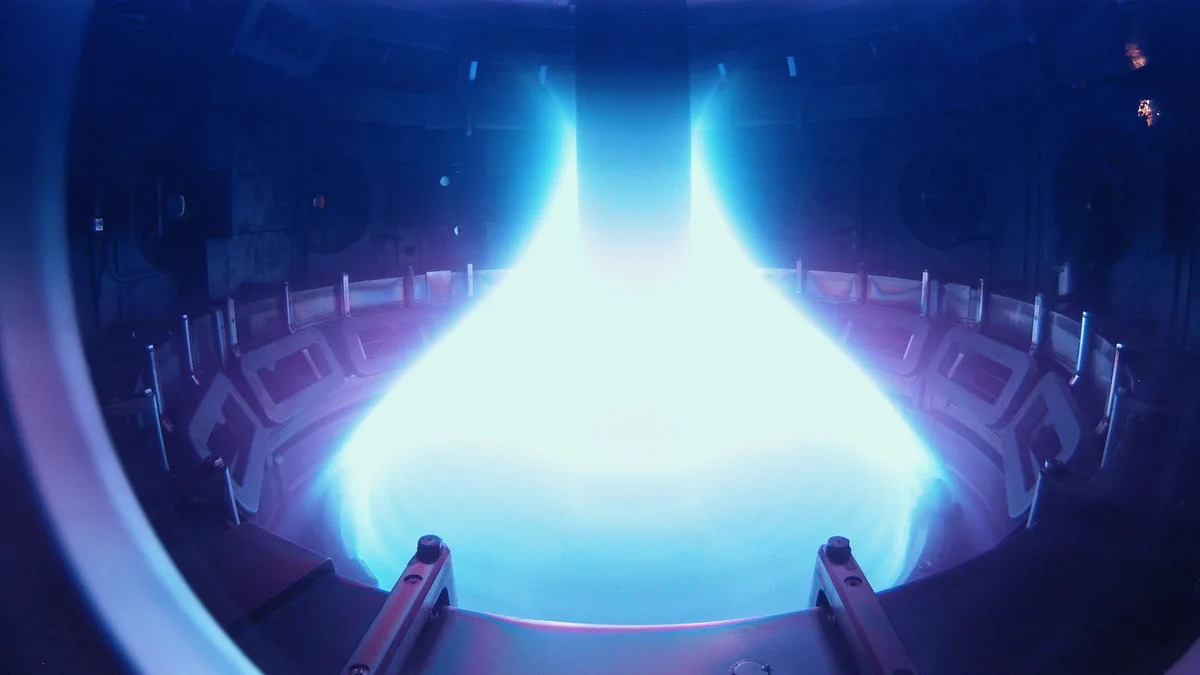
Starforge plans to design and build compact spherical tokamaks, a compact version of the doughnut-shaped machines that hold superheated plasma in place with magnetic fields. Each reactor would produce 200 to 300 megawatts of electricity, which falls within the size range the International Atomic Energy Agency uses for small modular reactors.
Rather than developing power plants and selling electricity itself, the company wants to sell reactors into the procurement processes that utilities and governments already use, in the way fission vendors such as Westinghouse and Framatome supply reactors today, The Next Web reported. Turbines, grid connections and electricity sales would stay with the customer.
Because buyers could add capacity one unit at a time, Starforge sees customers beyond national grids, including data centres, district and industrial heating, and remote research and defence sites.
Built for repetition
The core argument is about manufacturing. First Momentum wrote that after more than 200 tokamaks, no fusion machine has been built twice, because each one was built to answer a physics question. Starforge designs every component to be produced repeatedly in a factory and says its conservative model shows costs falling 15% with each doubling of production, pointing to electricity at around 5 cents per kilowatt hour at fleet scale.
That is an assumption, not a result. The Next Web noted that an ETH Zurich study published in Nature Energy in April put the likely cost decline for fusion at 2% to 8% per doubling of capacity, against 23% for solar modules. Starforge's bet is that factory production can beat that curve.
Its first reactor, Unit One, will use remountable high-temperature superconducting magnets and modular systems so that parts can be serviced in the field over a lifetime of more than 40 years. The company says Unit One will be prototype, first-of-a-kind unit and first commercial product in one.
The founders
Chief executive Ana Koller previously worked at Commonwealth Fusion Systems, MIT and the Max Planck Institute for Plasma Physics. Co-founder Jonathan Janssen ran production ramp-ups at GE, Lilium and VoltStorage, according to First Momentum. "Starforge wants to make fusion boring: a utility people drive past without a second thought," Koller said.
Philip Specht, general partner at AENU, said fusion can provide clean power that does not depend on the weather, "but only if it becomes affordable and fast to deploy".
What the money is for
Over the next 24 months Starforge will grow its team, de-risk its key reactor technology, complete the conceptual design of Unit One and seek initial commitments from reactor customers across Europe, Tech Funding News reported. It targets first commercial operations in the mid-2030s.
Why it matters
Germany wants to host the world's first fusion power plant and launched a EUR 500 million programme for fusion start-ups in October, The Next Web noted. Starforge joins a German field that includes stellarator developers Proxima Fusion and Gauss Fusion. First Momentum, which also backs Gauss Fusion, says it now supports both leading magnetic confinement designs.
What it means for European founders and investors
For deep tech founders, Starforge shows that a credible pre-seed in a capital-heavy field can be built on a business model insight rather than a physics breakthrough: the team takes validated magnet and tokamak science as given and puts its engineering budget into manufacturability.
For investors, the round size is small for fusion, where private companies have raised USD 14.24 billion since 2021 according to First Momentum, without yet supplying net power to a grid. The milestones to watch are the Unit One conceptual design and any early customer commitments. More start-up news is in our startups section.
Spotted an error? Email contact@europreneursmedia.com and we'll correct it. See our corrections policy and editorial standards.