Asynchronics raises USD 3.1m seed to make spacecraft digital twins off the shelf
Founded by two former Airbus engineers, the startup wants satellite components to ship with reusable digital models and plans at least 50 of them within two years.
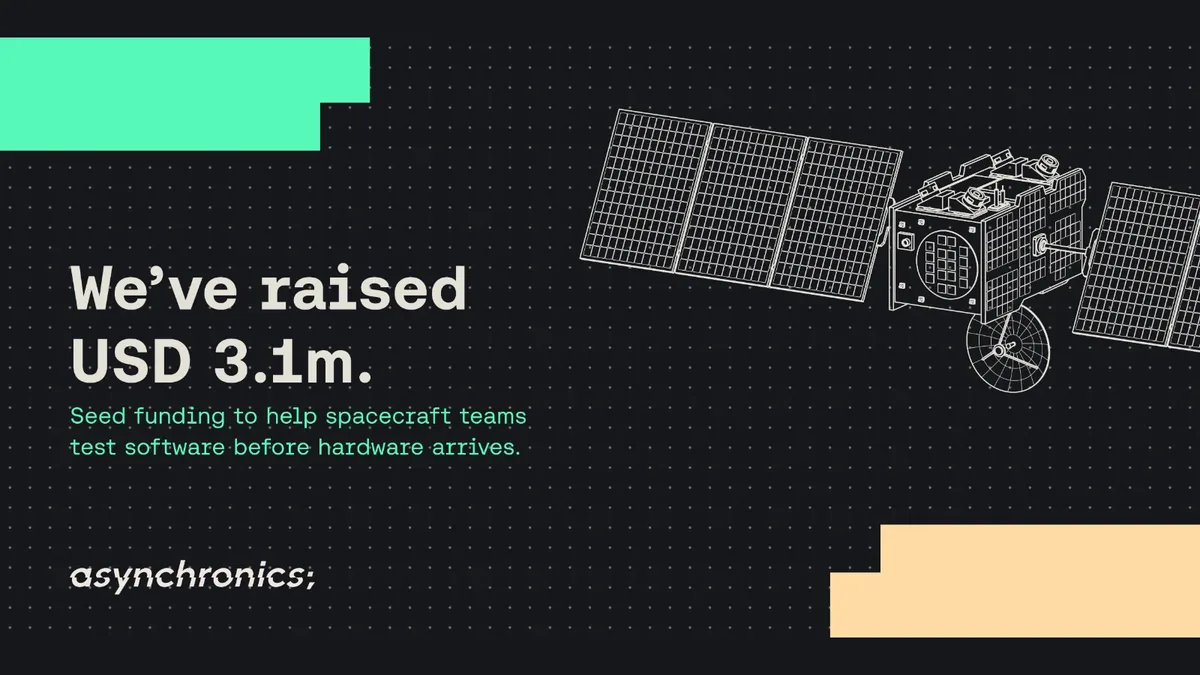
Asynchronics, a Warsaw-based developer of spacecraft simulation software, has raised USD 3.1 million in a seed round led by b2venture, with participation from Movens Capital, Heartfelt and Hard2beat, the company announced on 17 November.
The funding will be used to expand its catalogue of digital twins of spacecraft components, build tools for systems engineers and grow the team, including a planned office in Toulouse.
The problem it is solving
Building and maintaining high-fidelity spacecraft simulators takes substantial engineering work, and New Space teams rarely have the resources that established space companies have spent decades building up, chief executive and co-founder Adam Chikha wrote in the announcement. When hardware arrives late and the launch date is already fixed, teams end up squeezing months of integration and testing into a much shorter window.
System simulation lets teams test software, component interactions and failure scenarios before the complete spacecraft exists. Asynchronics wants that to become a routine part of spacecraft development from the earliest stages of a mission.
The product
At the core of the company is NeXosim, its open-source simulation engine, written in Rust. "NeXosim automatically runs simulation models in parallel, with the engine handling the necessary synchronization," said co-founder and chief technology officer Serge Barral. He said the team chose Rust for its strengths in concurrent programming after working with system-level simulators written in C++ at large space integrators.
On top of the engine, Asynchronics is building NeXosim.io, a marketplace for reusable component models. The idea is that when engineers select a component, they can get a model directly from its manufacturer and start testing its integration straight away, instead of each customer rebuilding the same behaviour from documentation.
"Smaller companies or mid-sized companies do not have access to this kind of simulation tooling," Chikha told Payload. "It lets the smaller companies create better simulations of their missions, and start competing with big industry."
Team and customers
Chikha and Barral, both Airbus veterans, founded the company in 2023, Payload reported. In its investment note, b2venture said Barral has more than 20 years in space, holds a PhD in space propulsion and previously led R&D at an Airbus joint venture, while Chikha has more than ten years in space and defence, including roles at Airbus and as simulation lead at Metrea.
Asynchronics is building complete virtual test environments for Infinite Orbits' Endurance and Orbit Guard 3 missions, according to the company. It has developed four models of NewSpace Systems hardware: a reaction wheel, a magnetometer, a GPS receiver and a sun sensor. Payload also named K2 Space among the companies using its tools. With Infinite Orbits, it is developing a digital twin of a servicing satellite, a project for which the two companies received a total of EUR 450,000 from the European Space Agency, Puls Biznesu reported.
What the money is for
Over the next 24 months, Asynchronics aims to expand its catalogue to at least 50 digital twins and is developing a graphical interface so systems engineers can combine models into a simulation environment, configure tests and examine results. It will also explore AI-assisted tools internally to turn technical data into first drafts of models, with engineers reviewing and validating each one before customers rely on it.
Paulina Prachnio-Janušauskas will join to drive commercial growth, bringing experience from building neptune.ai, which was acquired by OpenAI. Payload reported that the company plans to grow from about 11 employees to 24. Puls Biznesu reported revenue of around EUR 1 million last year, including research grants and public programme support.
Space is the immediate focus, but Asynchronics says NeXosim was designed as a general-purpose engine and that it intends to bring the technology to defence, robotics and other industries where complex hardware and software must work together.
Why it matters
Europe's New Space sector is producing more satellites and components, and testing capacity has to keep up. Asynchronics' bet is that standardised, off-the-shelf components should come with standardised digital models, which would cut duplicated engineering work across missions. Other recent European space rounds include Dcubed's EUR 27.2m round and Gama's EUR 15m round. More early-stage companies are covered in our Startups section.
Spotted an error? Email contact@europreneursmedia.com and we'll correct it. See our corrections policy and editorial standards.