Elysian Aircraft closes pre-Series A for its 90-seat electric E9X
The Hoofddorp company is designing a battery-electric airliner for about 90 passengers and now also works on unmanned aircraft technology for the Dutch defence ministry.
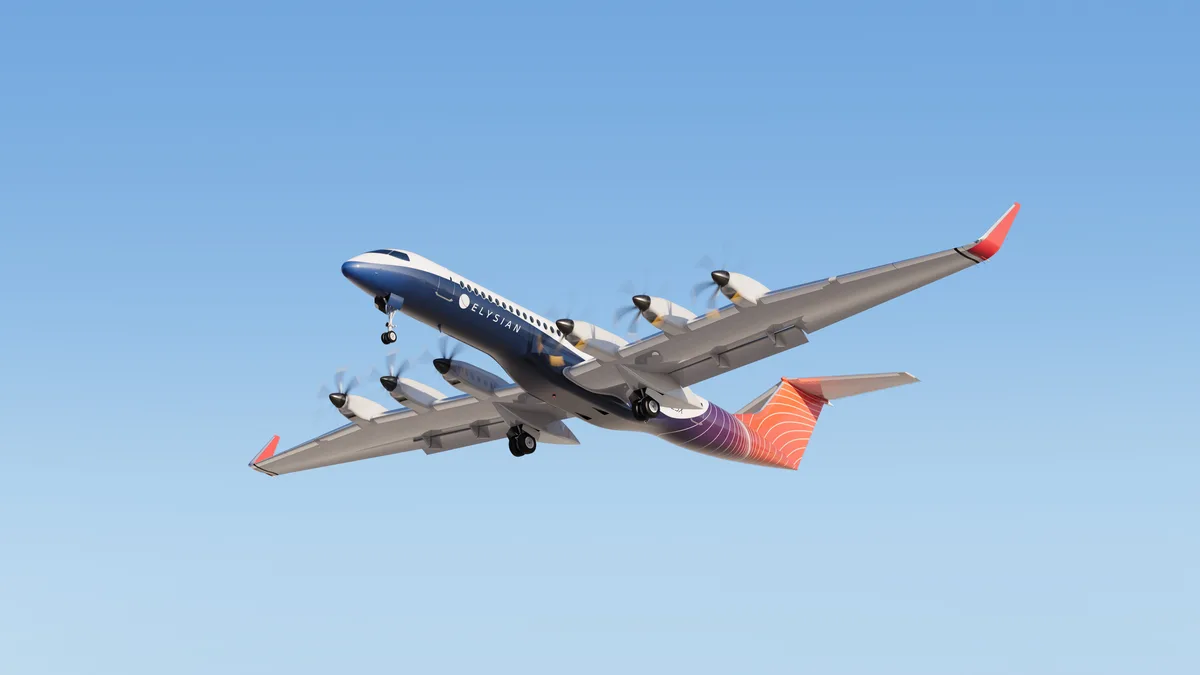
Elysian Aircraft, a Dutch company developing battery-electric aircraft technology, has closed a pre-Series A funding round backed by venture firm FideFlux, defence investor SecFund and ROM InWest, the regional development agency of North Holland, alongside individual investors and family offices, the company announced on 19 November at the NEDS defence and security exhibition in Rotterdam.
The company did not state the size of the round in its announcement. EU-Startups reported that Elysian raised more than EUR 6 million in equity alongside more than EUR 6 million in public funding, and more than EUR 20 million in total including earlier rounds. Aviation Week described the financing as undisclosed.
A regional airliner on batteries
Founded in 2023 by Daniel Rosen Jacobson, Rob Wolleswinkel and Reynard de Vries, Elysian is based in Hoofddorp near Amsterdam Schiphol. Its central project is the E9X, a battery-electric passenger aircraft designed to carry around 90 people over distances of up to 1,000 km. Aviation Week noted that the design is as heavy as an Airbus A321neo, with a longer wingspan.
That puts Elysian in a different market from the many eVTOL startups building two to four seat air taxis. It is aiming at mainstream short-haul routes flown by regional airlines today. The company cites a 2025 CE Delft study to argue that battery-electric propulsion loses about 18 percent of energy, compared with 65 to 81 percent for alternatives such as hydrogen fuel cells or synthetic e-fuels, EU-Startups reported. These are the company's figures.
Elysian works with research and industry partners including TU Delft, the Netherlands Aerospace Centre (NLR) and Fokker Services Group, according to EU-Startups.
The defence angle
The round follows a technology programme awarded by the Dutch Ministry of Defence to a consortium jointly led by Elysian and NLR, focused on technologies for next-generation unmanned aircraft. SecFund's investment was made with funds provided by the ministry. SecFund is a collaboration between the Ministry of Defence, the Ministry of Economic Affairs and the Dutch regional development agencies, and backs startups and SMEs that meet the ministry's innovation needs.
"For defence, access to the best Dutch technology is becoming increasingly important," said Ernst Coolen, investment director at SecFund. "This is dual-use in practice, and exactly the kind of innovation we aim to accelerate through SecFund."
Wouter Lammerse, general partner at FideFlux, called the company "technically daring and internationally relevant". Gijs Schot of ROM InWest pointed to Elysian's roots in the Schiphol region and its network of aviation partners there.
Next step: a Series A in 2027
Elysian says the money will go into its core aviation electrification technologies, the technical problems of battery-electric flight, and applications in both civil and defence aviation. It plans a Series A round in 2027.
"This investment is an important vote of confidence in our team, our technology and the direction we are taking," said co-founder and co-CEO Rosen Jacobson. "With the support of our new and existing investors, we will use the coming months to deliver the technical, commercial and financial milestones that set Elysian up for a Series A in 2027."
What it means for founders and investors
Elysian's round comes two weeks after German electric aircraft startup Vaeridion raised a Series A2. Both show how hard it is to fund aircraft development with venture capital alone: Elysian's round mixes private equity with public money, and a regional agency sits next to a VC firm on the cap table.
The bigger shift is the defence link. Across Europe, ministries and new defence funds are looking for dual-use technology, and climate tech hardware companies are finding that work on unmanned systems can bring in revenue and grants years before a certified passenger aircraft. For founders in deep tech, that can extend the runway. The trade-off is focus: building a 90 seat airliner is already a very long and expensive programme, and investors will watch whether defence projects support the E9X or pull engineering time away from it.
For investors, the 2027 Series A will be the real test of appetite for large battery-electric aircraft, given that battery energy density still limits range and payload. For more rounds, see our funding section.
Spotted an error? Email contact@europreneursmedia.com and we'll correct it. See our corrections policy and editorial standards.