Qluster raises EUR 4.7m to build a photonic quantum computer
The four founder team comes out of the Laboratoire Kastler Brossel. It wants an intermediate-scale machine by 2032 and a fault-tolerant universal quantum computer by 2036.
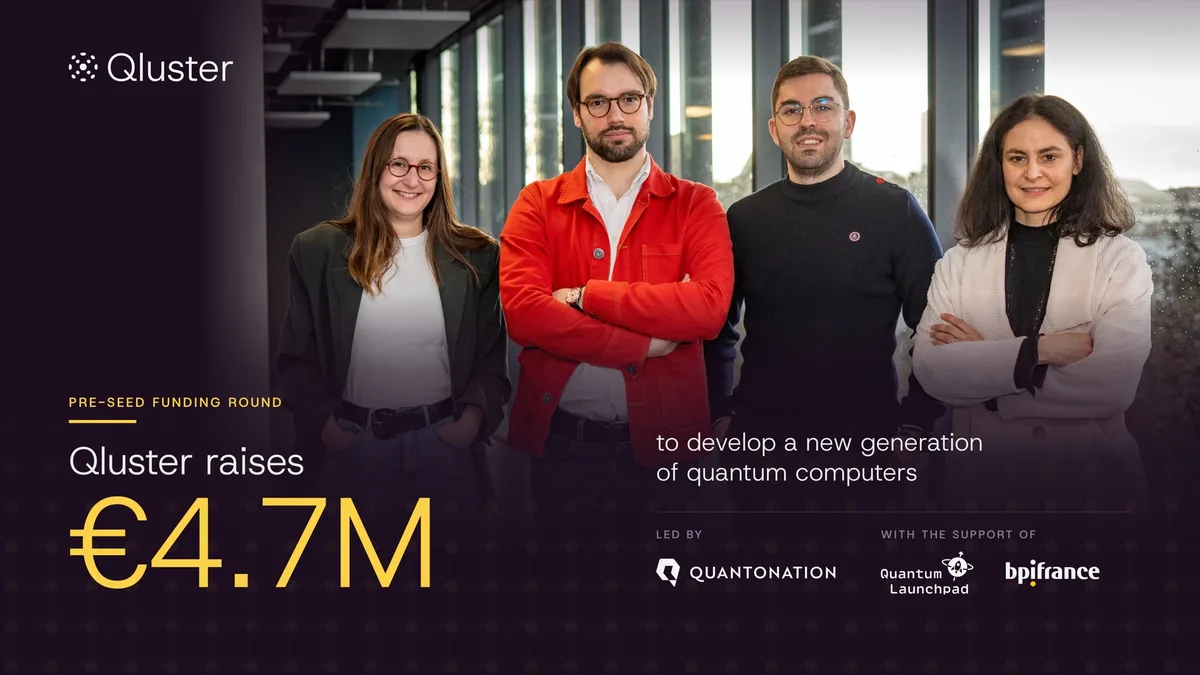
Qluster, a Paris quantum computing startup spun out of the Laboratoire Kastler Brossel, has raised EUR 4.7 million in its first funding round, the company announced on 17 November. The pre-seed round was led by Quantonation, a fund specialising in quantum technologies and physics-based innovation, with support from Quantum Launchpad and Bpifrance.
The laboratory behind Qluster is run by Sorbonne Université, CNRS, the École normale supérieure and the Collège de France, Quantum Computing Report noted. The company says the lab's history is associated with three Nobel Prizes in Physics.
Four founders, a few months old
Qluster was founded only a few months ago, the company says, by a team of four. David Fainsin (CEO) and Ambroise Boyer (CTO) both hold PhDs in quantum optics. Clarisse Thibault (COO) previously worked at CNRS Innovation. Valentina Parigi (CSO) is a physicist and professor at Sorbonne University and chairs the startup's scientific advisory board. The company has already won the 2026 i-Lab Grand Prize, a French innovation competition supported by France 2030, and has been supported by Quantum Launchpad and the incubator Agoranov since it started.
Its technology builds on a patented miniature photonic source developed by Parigi and Fainsin at the Laboratoire Kastler Brossel. Qluster says the principle behind it has been experimentally validated and published in a scientific journal, and that it is one of the basic building blocks of its future machine.
Light instead of chilled circuits
Most quantum computers that make headlines use superconducting circuits or trapped atoms or ions. Qluster takes a different route: continuous-variable photonic quantum computing. It uses light to carry information and encodes it in the continuous properties of the electromagnetic field rather than in individual two-level qubits. This approach can generate large entangled states, known as clusters, which supply the resources for quantum operations. The company says it opens the way to architectures that process large numbers of quantum modes at room temperature, which should make machines easier to scale and stabilise.
The second part of its pitch is what it calls "Architecture First". Instead of starting from a qubit technology, Qluster translates industrial problems into quantum circuits, works out what they need in qubits, circuit depth, speed and energy, and designs the machine around those requirements. The company says this approach is backed by significant investment in North America and Japan but remains relatively underdeveloped in Europe.
"For several years, the race to build quantum computers has largely focused on developing increasingly powerful qubits. But the challenge today is to ensure that the computing architecture can meet the needs of industry," Fainsin said.
A long road map
Qluster plans to build an intermediate-scale quantum computer able to solve first industrial problems by 2032. By 2036 it aims for a universal, fault-tolerant machine with thousands of logical qubits that can run billions of operations, at a size, energy use and operating cost that businesses can accept.
The pre-seed money is for the first steps. Qluster will set up its own R&D laboratory to improve its photonic technology and recruit experimental physicists as well as specialists in quantum computing theory and architecture, so hardware and system design can advance in parallel. Law firm Gide, which advised Qluster on the round, said the goal is to grow to around fifteen people by the end of 2027.
Fainsin was careful about expectations. The approach "certainly does not eliminate the scientific and technological challenges that still need to be overcome to build a reliable quantum computer," he said, but it builds on photonics, a field in which he says Europe has world-class expertise, and offers promising prospects for scalability.
What it means for founders and investors
France has become one of Europe's busiest quantum hubs, with hardware companies such as Pasqal, Quandela and Alice & Bob already well known. Qluster adds a new technical bet to that mix and shows how the French system feeds deep tech startups: a public research lab, a national innovation prize, an incubator, a specialist fund and Bpifrance all appear in a single small round. The European Innovation Council's 2027 work programme adds further grant and equity options for companies at this stage.
For investors, the time horizon is the main point. A ten year road map to a fault-tolerant machine means many more funding rounds, and success depends on physics milestones as much as on markets. Specialist funds such as Quantonation exist to take that risk early. For founders in other deep tech fields, Qluster's "Architecture First" framing is a useful lesson: starting from what customers will need to compute, not from the component a lab happens to master, makes a long research programme easier to explain. More technology stories are in our AI and tech section.
Spotted an error? Email contact@europreneursmedia.com and we'll correct it. See our corrections policy and editorial standards.